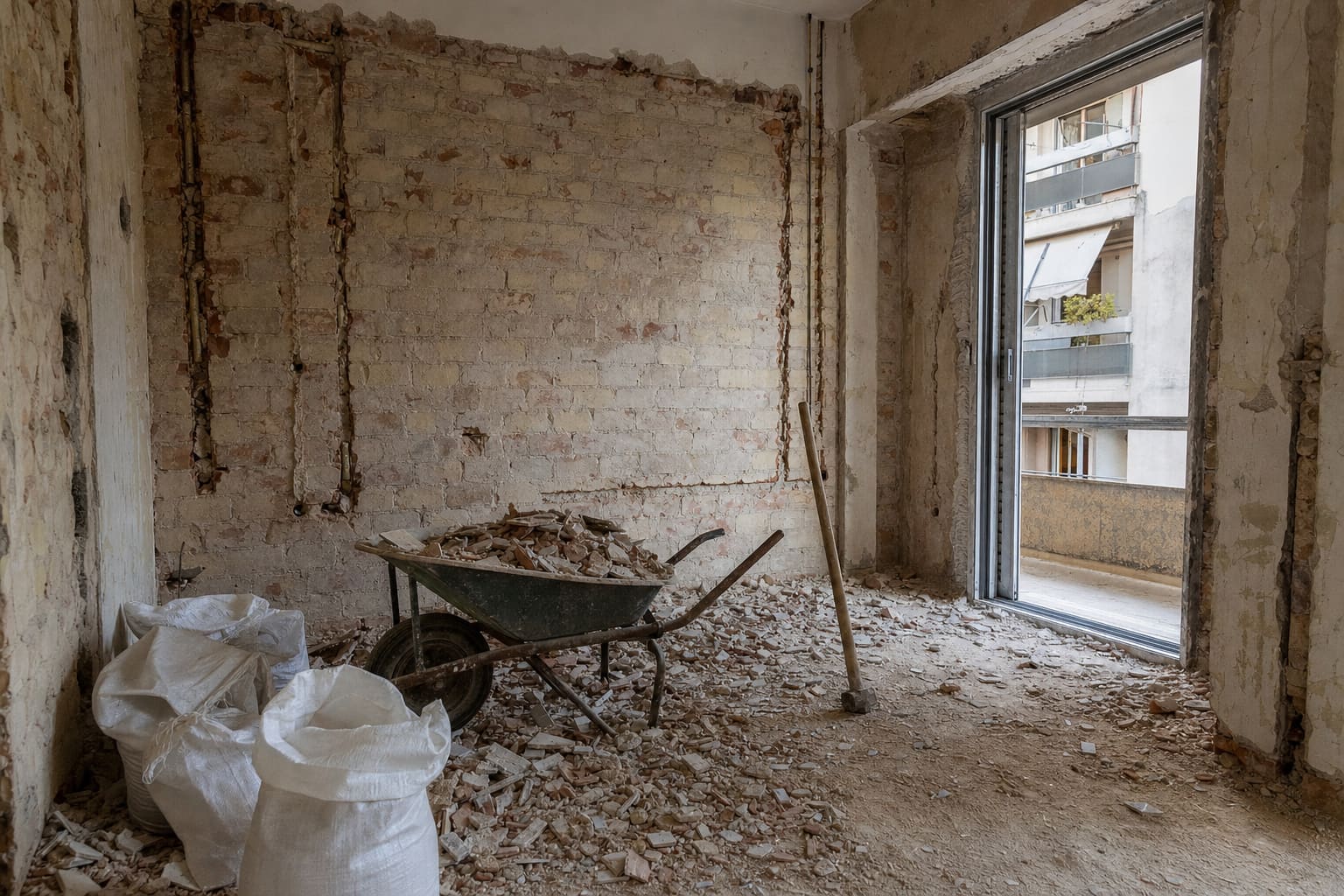
How much rubble each job makes
The table shows rubble after it has been broken up, in cubic metres and tonnes. Treat the figures as rough. The real load depends on how thick the layers are and how you strip them.
| Job | m³ | Tonnes, approx. | Skip |
|---|---|---|---|
| Bathroom, 4–5 m²: tiles, adhesive, floor screed, sanitary ware | 2–4 | 3–6 | 3 m³. If that size is not offered near you, an 8 m³ skip half full |
| Kitchen: units, worktop, wall tiles | 3–5 | 1.5–3 | 6 or 8 m³ |
| Floor tiles or mosaic with adhesive and screed, per 10 m² | 0.6–0.8 | 0.8–1.3 | 3 m³ up to 40 m² |
| Brick wall, per m² of wall | 0.10–0.14 | 0.12–0.2 | 3 m³ for one partition, 8 m³ for several walls |
| Plaster stripped 2 cm thick, per 10 m² of wall | 0.3–0.4 | 0.4–0.6 | Goes in with the rest of the rubble |
| Aluminium frames and shutters, a flat with 6–8 openings | 1–2 | 0.3–0.5 | Scrap metal, see below |
| Whole 70–90 m² flat from the 1970s | 12–25 | 15–30 | 8 m³, three or four loads |
| Flat roof, 40 m²: slope screed, bitumen membranes, insulation | 3–5 | 4–7 | 8 m³ half full |
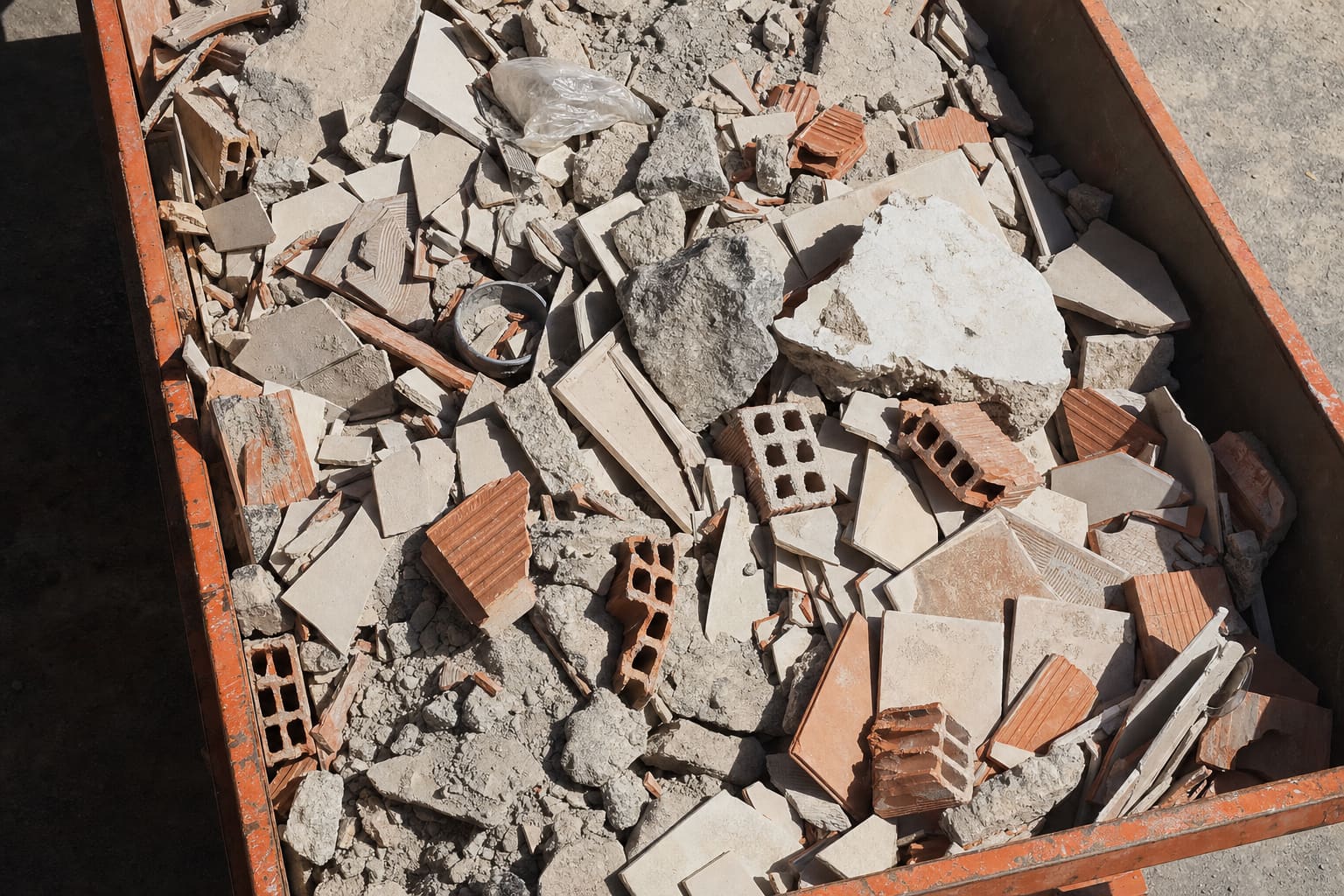
Aluminium frames and shutters are scrap metal, not rubble. They take up room but weigh little, so take them out on their own (keeping materials apart). The volumes above match our skip size guide.
One small bathroom or a few tiles? Have a look at the 3 m³ mini skip. Below 1 m³, rubble bags are cheaper.
How to work it out yourself
Multiply area × thickness × bulking factor, with thickness in metres. The bulking factor tells you how much more room the broken pieces take than the layer did in place.
| Material | Bulking factor | Example |
|---|---|---|
| Ceramic tiles with adhesive | 1.3 | 10 m² × 0.05 m × 1.3 = 0.65 m³ |
| Hollow brick, partitions | 1.4 | 7.5 m² × 0.10 m × 1.4 = 1.05 m³ |
| Concrete, solid masonry | 1.5 up to 1.7 | 10 m² × 0.10 m × 1.5 = 1.5 m³ |
| Plaster | 1.25–1.4 | 10 m² × 0.02 m × 1.3 = 0.26 m³ |
To get tonnes, multiply the cubic metres by 1.2–1.6 for mixed rubble, or by about 1.8–2.4 for concrete and stone. The Greek construction-waste recycling scheme assumes 1.6 tonnes per m³ for demolition. It has no set method for renovations, so add a 20% margin to your own figures. The bulking factors are practical ranges, since we found no official Greek figure.
With heavy rubble, weight matters before volume. An 8 m³ skip full of rubble weighs more than the lorry can lift, so we only fill it to about halfway. The size guide shows how that plays out for each size.
Put your jobs into the calculator
Tick what you are doing and how many times. The numbers are for waste already broken up, which takes more room than the wall or floor it came from.
Bathroom stripped out
one bathroom of about 4–5 m² · 2–4 m³
0Kitchen taken out
units, worktop, wall tiles · 3–5 m³
0Floor tiles lifted
per 10 m² of floor, with the adhesive · 0.6–0.8 m³
0Brick wall knocked down
per 10 m² of wall · 1–1.4 m³
0Whole flat renovated
flat of about 70 m² · 12–20 m³
0Flat or house cleared out
furniture and belongings, about 70 m² · 8–15 m³
0Storeroom or basement emptied
one storeroom · 3–8 m³
0Garden cleared
prunings and green waste of a yard · 3–8 m³
0
Tick at least one job.
Enter what you are stripping and how many of each: one bathroom, 30 m² of floor tiles, one partition. The tool adds up the cubic metres and suggests a size. If you are unsure, go with the bigger figure. Spare room costs nothing, but a skip that fills up halfway through the job means a second order.
Order of works and when to bring the skip
Have the skip arrive on the day the demolition starts, and let it go once that is finished. Most of the rubble comes out first, and the rest of the job is cleaner.
- Demolition: tiles, plaster, partitions, sanitary ware, units. This is where 80–90% of the rubble comes from, so the skip needs to be on site already.
- Chasing walls for plumbing and electrics: a small load of dust and chips. It goes in the same skip, if that has not left yet.
- Screeds, tiling, painting: you are left with empty adhesive sacks, cardboard and a few tiles. Those fit in rubble bags or on top of the last skip.
The price covers 10 days of rental, and every extra day is €5. If the demolition finishes early, message us in the chat and we will collect sooner. Living in a block of flats, where the rubble goes down by hand or in the lift? Read our guide to renovating in a flat.
Keeping materials apart
Clean rubble recycles more easily than a mixed load. The recycling plant sorts whatever it finds in the skip, and the cleaner the load, the less work it has.
- Clean rubble: tiles, plaster, brick, concrete. Load it first, spread across the floor of the skip, up to halfway.
- Timber, doors, units, plasterboard: on top, as they are light.
- Aluminium, iron, pipes: keep these apart. Scrap metal has a value and the tradesman will often keep it. If he does not want it, it can go in the skip as well.
- Glass from frames: wrapped up, not loose, so that nobody gets cut while loading.
Heavy rubble in an 8 m³ skip: to about half
Rubble first, light waste on top, up to the rim
Nothing above the rim
If you want the metal and timber kept entirely apart from the rubble, order a second, smaller skip. A 3 m³ skip (€190) takes the frames, timber and plasterboard from one flat.
What must not go in
Asbestos cement, paint, solvents, batteries and electrical appliances stay out of the skip. A renovation turns them up more often than you would think.
- Asbestos cement (ελενίτ): water, drain or flue pipes behind old bathrooms, and sheets on the flat roof or roof of an older building. If you suspect it, leave it unbroken and read our asbestos guide.
- Paint, varnish, solvents, solvent-based adhesives: empty tins with residue count too. Take them to the collection point your municipality names.
- Electrical appliances: water heaters, air conditioners, fridges, cookers. They go separately. See our guide to what goes in a skip.
Approval of works and the rubble
Small-scale works, which covers many renovations, need an approval of small-scale building works. An engineer files it on the TEE e-Άδειες platform. It rests on Law 4495/2017 (article 29 onwards) and ministerial decision ΥΠΕΝ/ΔΑΟΚΑ/43266/1174/2020, and it is valid for one year. Your engineer will tell you which works need it and which do not. We cannot.
The procedure is described officially in the national register of administrative procedures. Its list of documents says nothing about construction waste. Waste specialists, though, write that the file asks for a waste management plan and a contract with an approved recycling scheme. Ask your engineer what your own file requires.
The rule for the rubble is the same with or without a permit: the owner who produces it is responsible for it reaching a licensed plant. We take it to a licensed ΑΕΚΚ recycling plant. The guide to legal disposal says what paperwork to ask for from whoever carries your rubble, and the ΑΕΚΚ guide explains the scheme.