The short answer: where the line is
Cubic metres, weight and stairs set the line. Up to about 30 bags, sacks have no rival. A handful of rubble is not worth a street permit or a wait for a lorry.
| Option | Volume | Rubble weight | How it leaves | Fits |
|---|---|---|---|---|
| 50-litre sacks | 0.05 m³ each | 40–60 kg each | On a shoulder, then a licensed carrier | Up to 1 m³ (30 sacks) |
| Big bag | 0.7–1 m³ | up to 1–1.5 tonnes | Crane lorry, private ground | 1–2 m³ |
| 3 m³ skip | 3 m³ (about 90 sacks) | 4–5 tonnes | Skip lorry, collection included, €190 | 2–3 m³: a bathroom, a storeroom |
| 8 m³ skip | 8 m³ (250–270 sacks) | with rubble half full, 5–6 tonnes | Skip lorry, collection included, €240 | Big jobs, lots of light waste |
We do not sell bags. We bring skips, and on plenty of jobs the two go side by side, as you will see below. If you cannot tell how many cubic metres your job makes, what size skip do I need has a calculator.
The kinds of bag and what each one holds
Greece has three kinds, and one will not stand in for another.
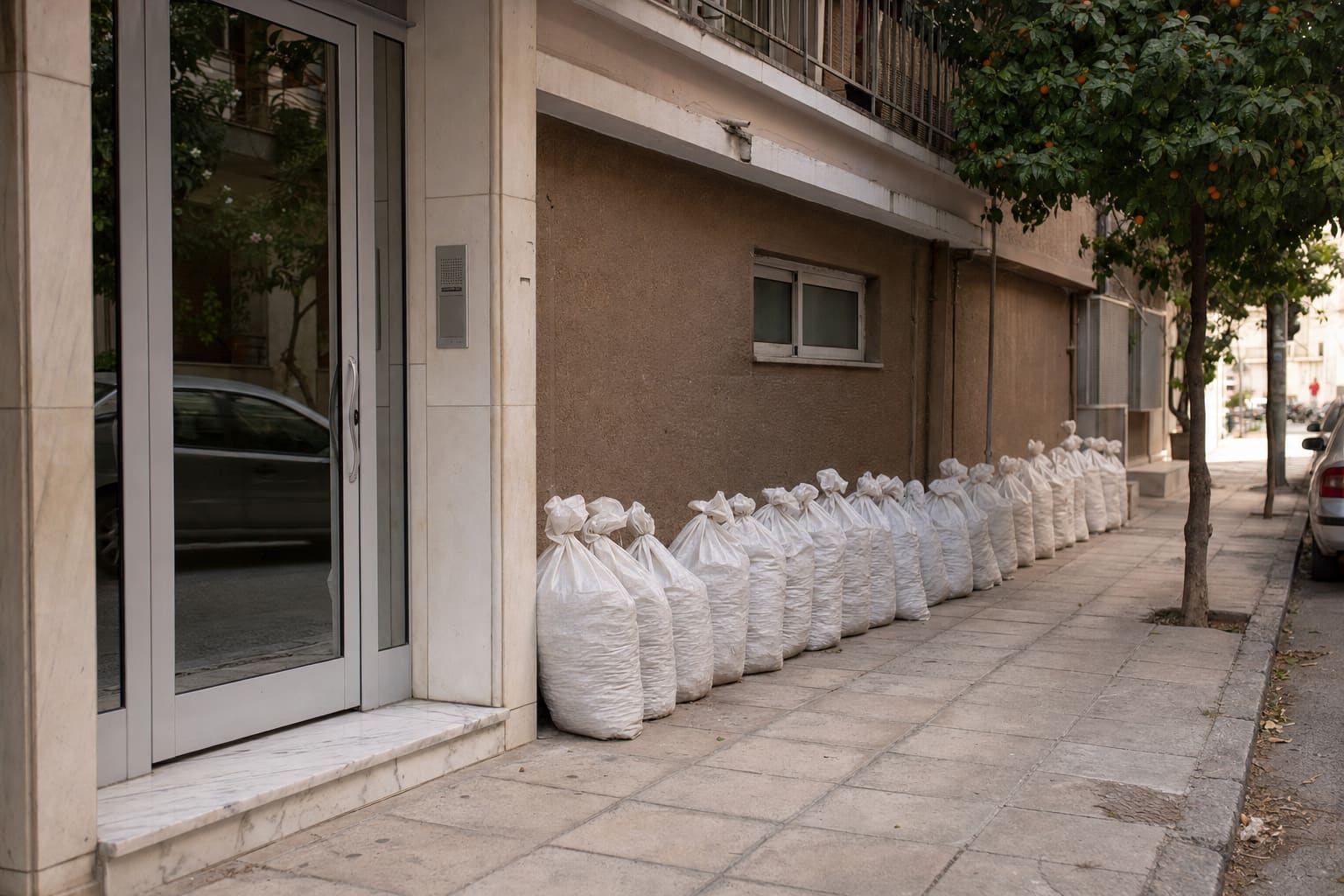
- The 50-litre τσουβάλι. Woven plastic, about 50 × 80 cm. A labourer fills it and carries it down on his shoulder. It is the renovation bag you see piled outside blocks of flats.
- The rubble sack. Thick plastic, usually rated to 25 kg and sold in packs by the big building stores. Sharp edges split it, so it is no good for tiles.
- The big bag (σάκος μπάζων). A large woven sack with four lifting straps, 0.7 to 1 m³. It stands on the ground and a crane lorry picks it up.
The 1-tonne big bag is usually 90 × 90 × 90 cm, or 0.73 m³. That is deliberate: 0.73 m³ of broken rubble weighs about a tonne, which is all the sack can take.
How heavy a bag of rubble is
A 50-litre sack of tiles, plaster or brick weighs 40–60 kg filled normally, and that is already heavy on a staircase. The sum is easy: broken rubble comes to about 1.2–1.6 tonnes per m³, which is 1.2–1.6 kg a litre. Fill fifty litres to the brim and you are at 60–80 kg.
Whole concrete and tile weigh more again. In the construction-waste price list used by the Municipality of Patras, concrete and ceramics count as 2.24 tonnes per m³ (the municipal table). Once broken, the air between the pieces brings them down to the figures above.
How many bags make a cubic metre, a small skip and a big skip
| Space | 50-litre sacks (two-thirds full) | Note |
|---|---|---|
| 1 m³ | about 30 | Rubble weighs 1.2–1.6 tonnes |
| Small skip, 3 m³ | about 90 | Full of rubble: 4–5 tonnes |
| 8 m³ skip | 250–270 by volume | With rubble it fills to the middle, about 130 bags |
1 m³about 30 sacks
3 m³ mini skipabout 90 sacks
8 m³ skip250–270 sacks
- rubble
- room left for light waste only
One square is one 50-litre sack, filled two-thirds
Who takes bags away and where they can wait
The council refuse lorry will not take bags of rubble, apart from the small amounts your municipality sets. Rubble is ΑΕΚΚ (excavation, construction and demolition waste) and has to end up at a licensed plant. That is why bags need a licensed carrier, the same as a skip.
Many municipalities take a very small amount of rubble from minor repairs free of charge. In Thermi, for example, collection is free for up to five sacks of 10 kg, once every six months, and costs 2 to 5 euros a sack for 6 to 30 sacks (see the municipality page). Each municipality has its own rules, so ask your local cleaning department.
- Bags of rubble on the pavement, at a corner or beside the refuse and recycling bins.
- Rubble inside a recycling bin or a municipal bin.
- Bags in a shared yard or on a plot that is not yours.
Each municipality sets its fines in its own cleaning regulation, and they vary a lot. The amounts we found in official sources are in the guide on fines. Bags left on the pavement until a lorry arrives also need an occupation permit, just like a skip (municipal permit).
What bags cost and when a skip becomes cheaper
A skip comes out cheaper from about 2–3 m³, which is 60–90 bags. Bags get paid for twice: once for the sack and once for the load.
- Empty bags: cheap. Big bags run to about 5–10 euros each at building suppliers and packaging shops (the price depends on size and seller).
- Collection and disposal: the carrier charges per sack or per batch of sacks. Near 90 sacks the bill reaches that of a 3 m³ skip, which costs €190 with delivery, 10 days and disposal.
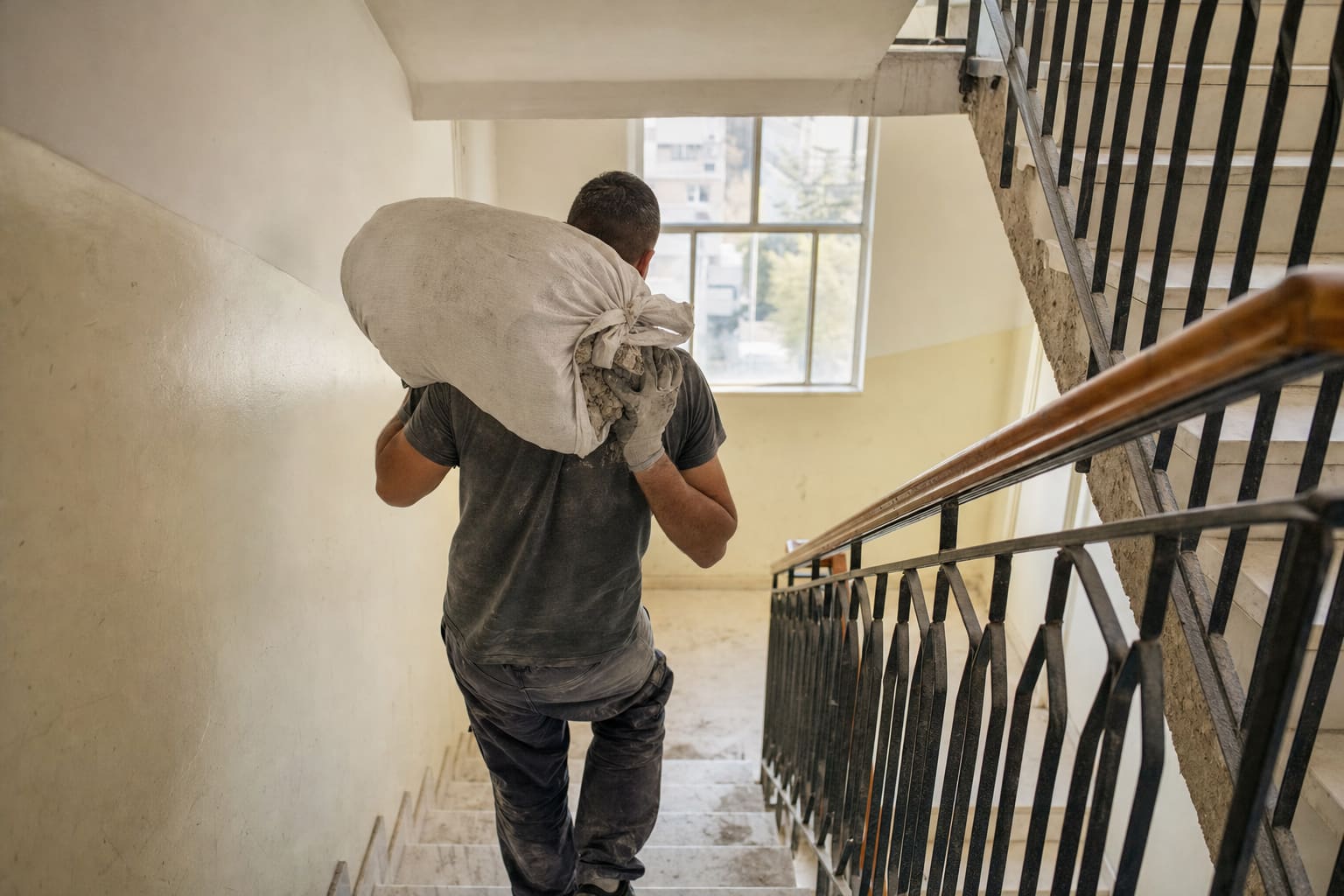
- Labour: every sack takes a person and a trip. Thirty sacks down from a third floor with no lift means thirty trips on one labourer’s shoulder.
Job, bags, skip
| Job | Rubble, m³ | 50-litre sacks | What pays off |
|---|---|---|---|
| Break out and replace 5 m² of floor tiles | 0.3–0.4 | 10–12 | Bags |
| Remove a basin, a bath or a small piece of wall | 0.3–0.6 | 10–18 | Bags |
| Brick wall, 10 m² | 1–1.4 | 30–42 | On the line: bags or the small skip |
| Floor tiles, 40 m² | 2.4–3.2 | 75–95 | 3 m³ skip |
| Strip a bathroom, 4–5 m² | 2–4 | 60–120 | 3 m³ skip |
| Strip a kitchen | 3–5 | 90–150 | 6 or 8 m³ skip |
| Renovate a 70 m² flat | 12–20 | 360–600 | 8 m³ skip, twice |
Apartment block: bags inside, skip outside
In a block, carry the rubble down in sacks and tip them into a skip on the pavement or in the pilotis. Nothing gets dragged across the road, and the skip fills from a whole floor’s work with no lorry trips in between.
- Stairs or lift: sacks go down with the labourer or in the lift, if the building rules allow it. Protect the floor and the cabin, and keep within the load limit on the lift’s plate.
- Chute (χωνί): from a balcony or scaffold, rubble drops straight into the skip with no sacks. The contractor sets it up, with a closed-off zone below and an eye on passers-by. The skip has to stand exactly under the outlet.
- Skip in the pilotis or yard: no municipal permit. On the pavement you need one, and you or the contractor apply for it.
A flat renovation has its own quirks, such as working hours and the neighbours. They are in the skip for an apartment and a block guide. The whole route, from strip-out to the last load, is in the renovation guide.