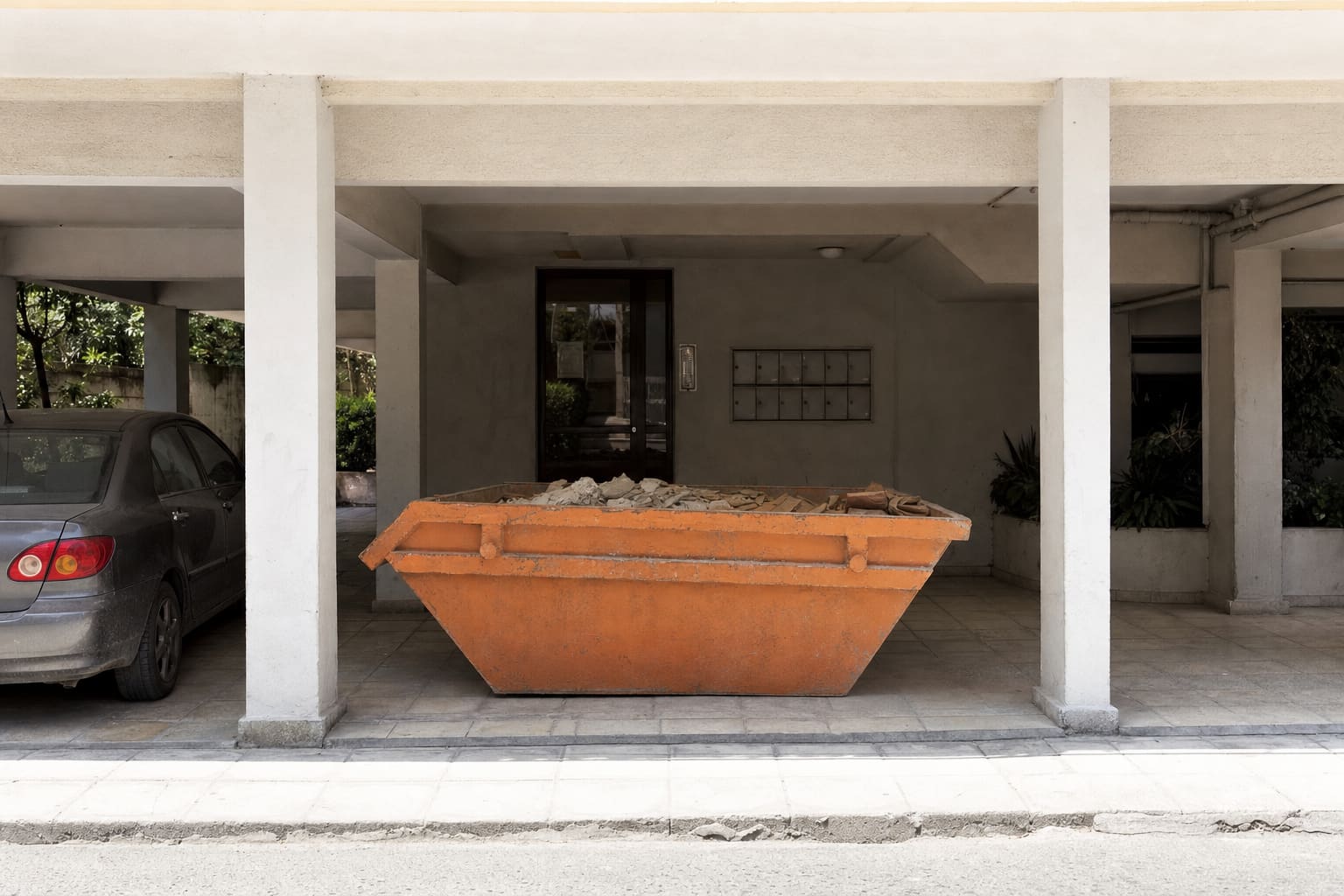
Where the skip can stand
There are three places, and a different person says yes to each. The municipality decides for the street or pavement in front of the block. The co-owners decide for the pilotis or the parking. The owner decides for a neighbouring plot.
- Street or pavement. The municipality has to grant a permit to occupy public space. Its fee is not in our price, and you or your contractor make the application. Steps and fees by municipality: Permit for a skip on the street.
- Pilotis, courtyard, the block’s own parking. No municipal permit, but the space is shared. The pilotis and the courtyard belong to all the owners unless the founding deed or the building rules divide them differently. That is the Civil Code (articles 1002 and 1117) and Law 3741/1929 on horizontal property. One owner cannot put a skip on a common area if it stops the others using it.
- Neighbouring plot. Only with the owner’s clear consent, ideally in writing. A vacant plot that looks abandoned is still not yours to use.
- 13 m³ mini skip: about 2.5 × 1.4 m, one parking space
- 28 m³ skip: about 3.8 × 1.6 m, two parking spaces
- 3Parallel to the kerb; a passage stays free for people on foot
- 4Reflectors or a small light at the corners at night
Before you order for the pilotis, read the building rules (κανονισμός) and ask the manager. If there are no rules, or they are silent, a decision at the owners’ meeting or a message from everyone is usually enough. You do not need a lawyer. You need nobody objecting.
How rubble comes down
Most people carry it down the stairs in bags. A chute from the balcony is quicker. The lift causes the arguments: many building rules ban rubble in the passenger lift, and rightly, since it breaks easily.
| Way | When it works | Watch out |
|---|---|---|
| 50-litre bags on the stairs | On any floor, for small and medium jobs | Fill them halfway, rubble is heavy. Sweep the stairwell every evening |
| Lift | Only if the building rules allow it, in bags and not loose | Mind the cabin’s weight limit and cover the floor and walls. Dust and hard pieces damage the doors |
| Chute (χωνί) from a balcony | For a renovation on a high floor, when the skip can stand right below | Fix it firmly and fence off the area underneath. Cover the skip or the dust spreads down the street |
| Crane truck for big bags | For a lot of rubble, with access from a balcony or the courtyard | Needs room on the street and usually a permit. Your contractor sorts it out, not us |

Bags and a chute are not a luxury. A kitchen cupboard and two metres of tiles fill a bag in minutes, and a renovation produces hundreds. Work out early how many people it takes to carry them down and how long it will last. More on bags: Rubble in bags.
If rubble damages the lift, the repair bill usually goes to the flat’s owner or the contractor, not the common fund. Photograph the cabin before you start.
Quiet hours and noisy work
No breaking, chiselling or drilling during the quiet hours. In summer (1 April to 30 September) these are 15:00–17:30 and 23:00–07:00. In winter (1 October to 31 March) they are 15:30–17:30 and 22:00–07:30. They come from the police order on public peace, and offenders can be prosecuted.
In a block that means the bathroom comes out in the morning and the afternoon, with a gap at midday. Carrying rubble down makes less noise and can go on in the gap. The building rules may set a narrower window, and some municipalities add limits of their own. Ask the manager and follow the stricter one.
The skip keeps no such hours. It arrives and leaves Monday to Saturday, and you do not have to stop work for it.
The manager, the neighbours and the common areas
Tell the building manager (διαχειριστής) before the first day and pin a notice in the entrance. Put on it the dates, the working hours, who is doing the work and a phone number, yours or your contractor’s. Neighbours put up with noise more easily when they know when it stops.
- Cover the floor of the stairwell and the lift with cardboard or a protective sheet.
- Leave the entrance and the stairs clear so neighbours and older residents can get past.
- Clean the stairwell every evening, not only when the job is done.
- If something shared gets damaged (entrance door, tile, light), tell the manager straight away and take photos.
Whatever the flat’s owner or their contractor damages in the common parts, that owner normally pays for. If your contractor hauls rubble through the entrance as if it were his own, tell him on day one that it is not.
Do the works themselves need a permit?
Interior painting, repairing or replacing floors and small repairs inside the flat that leave the load-bearing structure alone need neither a building permit nor a small-scale works approval. For some of them, though, an engineer files an electronic notice in the ΤΕΕ system before work starts (ask yours). That is article 30 of Law 4495/2017, subject to special rules for the area or the building. Ministerial decisions have added to the list since.
If you move partition walls, open or close openings, or touch beams and columns, your civil engineer will say which procedure applies. We neither issue nor check permits. The rubble that comes out follows the same rules as any renovation: Renovation and rubble and Legal disposal at a recycling plant.
When to bring the skip and which size
Book the skip for the demolition days, not before. The price covers 10 days and every extra day is €5. Most of the rubble comes out in the first days. The weeks of wiring, tiling and painting that follow produce little.
If you order early in the day, the skip can arrive the same day; the form shows whether today is still open. Otherwise it comes on the next working day or any day you pick, Monday to Saturday.
On a tight street, its width settles the size. The 3 m³ skip (€190) fits where a bigger one will not, and does for one bathroom or one kitchen. A whole flat usually takes 6 m³ (€290) or 8 m³ (€240). See The 3 m³ mini skip and Which skip size do I need.
A skip on the street: neighbours and fines
A skip on an open street draws other people’s rubbish. Put a tarpaulin over it when you are not working, and do not keep it longer than you need. Mark it as rubble only. Nothing we refuse should go in, even if the neighbours offer.
Rubble piled on the pavement with no skip and no permit can bring a fine. The amounts vary by municipality and by offence: Fines for rubble and skips. In dense areas such as Athens, Kallithea or Thessaloniki, the municipalities check often.
Owner’s checklist before day one
- I have read what the building rules say about rubble, the lift and working hours.
- I have spoken to the manager and put a notice in the entrance.
- I have decided where the skip goes: street with a municipal permit, pilotis with the co-owners’ agreement, or private ground.
- I know whether the lift is allowed, with what weight limit, and I have protected it.
- I have 50-litre bags, and a chute if I am using one.
- The noisy parts of the job are planned outside the quiet hours.
- The skip is booked for the demolition days.