What goes in the skip
Almost everything that comes out of a renovation or a house clearance goes in the skip. We split it into four groups, the same ones as in the order form.
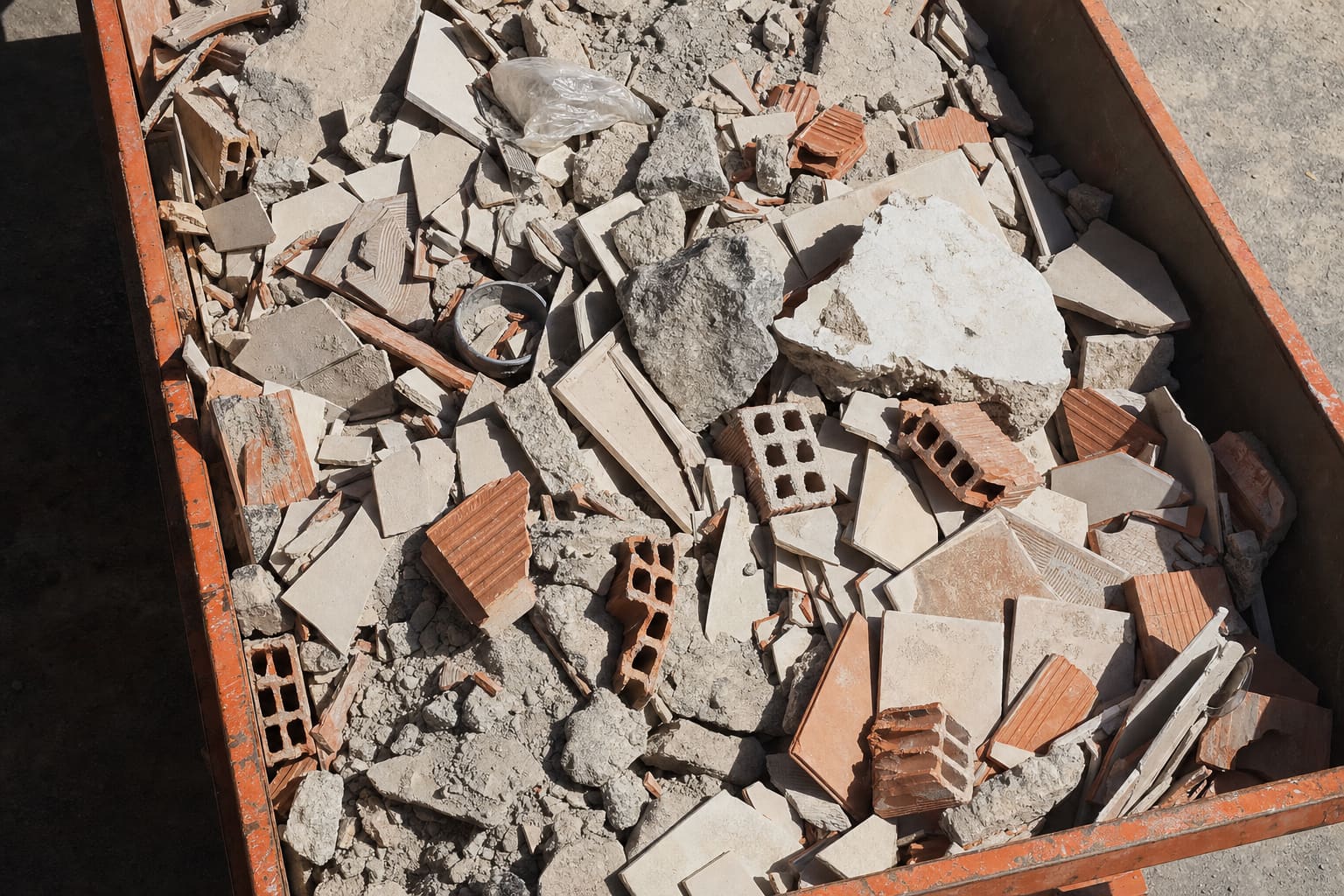
- Rubble and building materials. Broken tiles with their adhesive, plaster, bricks, concrete blocks, lumps of concrete, marble, mortar. Old toilets, basins and bathtubs. Plasterboard and false ceilings.
- Timber, metal, furniture. Doors, window frames, parquet, boards, pallets. Iron, railings, pipes, aluminium profiles. Old kitchens, cupboards, wardrobes, sofas, tables, beds. Mattresses, charged per piece.
- Garden. Prunings, grass, leaves, cut branches and trunks, garden soil, old flower pots.
- Packaging and mixed. Cardboard, plastic film, polystyrene, empty cement and adhesive bags. Clothes, toys, papers and everything else that collects in a storeroom or a basement.
If you have something that isn’t on the list, write to us in the chat before you load it. It is much easier to sort out before it goes in the skip.
What doesn’t go in, and where it goes instead
The site that takes the skip waste will not accept the items below. Most of them have their own recycling scheme, and often whoever sells you the new one takes the old one back.
| Item | Why it can’t go in | Where it goes |
|---|---|---|
| Asbestos, eternit (ελενίτ) | Dangerous fibres. No rubble site accepts it | A licensed asbestos-removal contractor (see below) |
| Liquid paint, varnish, solvents, chemicals | Hazardous waste, contaminates the whole load | Ask the municipality where it collects hazardous household waste. Paint that is still usable, give it away |
| Car and motorbike oil | Hazardous, has its own scheme | The garage that does the oil change. It hands it to the ΕΝΔΙΑΛΕ scheme |
| Batteries | Heavy metals and acid | Small batteries in the ΑΦΗΣ bins at supermarkets and shops. The garage that fits a new car battery keeps the old one |
| Gas cylinders | Can explode in the truck or at the site | Back to the shop where you swap cylinders |
| Car tyres | Banned from landfill | A tyre shop (βουλκανιζατέρ) or an Ecoelastika collection point |
| Fridges, air conditioners, water heaters, washing machines | Refrigerant gas, oils, electronics | The shop when you buy a new one, or Ανακύκλωση Συσκευών (see below) |
| Fluorescent and energy-saving bulbs | Contain mercury | The lamp bins in electrical shops |
| Food waste | Rots and smells, the site won’t take it | The municipal bins |
Heavy and bulky: how to load
In the form you pick the waste type: Construction, Garden, Furniture or General mixed. That tells us what we are lifting and which site to take it to. If you have a bit of everything, pick what there is most of and list the rest in the order comment.
Heavy rubble, meaning concrete, tiles, bricks, marble and soil, reaches the truck’s weight limit long before the skip is full. Furniture and prunings are light but bulky. So the waste type matters for the size too: if it is mostly heavy rubble, take a smaller skip. More in the guide Which skip size.
Heavy rubble in an 8 m³ skip: to about half
Rubble first, light waste on top, up to the rim
Nothing above the rim
- Heavy things at the bottom, spread across the whole skip. Light things on top.
- Take furniture apart and break up plasterboard, so there is no air in between.
- Don’t load above the rim. Whatever sticks out has to come off before the skip leaves.
- On the street, a skip collects other people’s things too: a fridge or a bag of rubbish from the next building. If you can, put it under the pilotis or in the yard, and take a look inside before it is collected.
One forbidden item can spoil the whole load. If the site finds eternit, paint or a fridge among the rubble, it can refuse the skip. The load then has to be sorted or taken elsewhere, and that cost is passed on to you.
Asbestos and eternit: never in a skip
Eternit (ελενίτ in Greek) is asbestos cement: the grey corrugated sheets on storeroom roofs, carports and chicken coops. The same material was used for old water and sewage pipes, chimneys and water tanks on flat roofs. You find it often in old houses and storerooms.
Asbestos does not go in a skip. Not one sheet, and not broken pieces hidden under the rest of the rubble. No construction waste site accepts it, and one piece is enough for the whole skip to be sent back.
Only a licensed asbestos-removal contractor may take it out. The contractor files the notifications that are needed, wets and wraps the sheets and sends them to a hazardous waste site. Ask them for a paper showing it was delivered. We don’t remove asbestos. Once the contractor is done, the rest of the rubble from the job goes in the skip as normal.
Don’t break, cut with a grinder or drill eternit. Don’t walk on an eternit roof: the sheets give way under your weight. If something is already broken, don’t sweep up the pieces dry; leave them where they are for the contractor. If you aren’t sure whether an old sheet is eternit, treat it as if it is until a specialist has seen it.
Fridges, air conditioners and other appliances
Anything that plugs in or runs on batteries is recycled separately, as electrical and electronic waste (ΑΗΗΕ in Greek). In a renovation that usually means the fridge, the cooker, the washing machine, the water heater, the air conditioners and electric radiators. Fridges and air conditioners hold refrigerant gas that has to be removed at a specialist plant.
- When you buy a new appliance, the shop takes the old one back. Say so when you book the delivery, so they take it the same day.
- Small appliances and bulbs go in the bins of Ανακύκλωση Συσκευών (Appliance Recycling) in electrical shops. There are more than 16,000 points around the country.
- Large appliances over 30 kg, or five small ones together, can be collected from your home. Ανακύκλωση Συσκευών lists the numbers for municipalities in Attica and Thessaloniki. In the other cities, ask the electrical shops or your municipality.
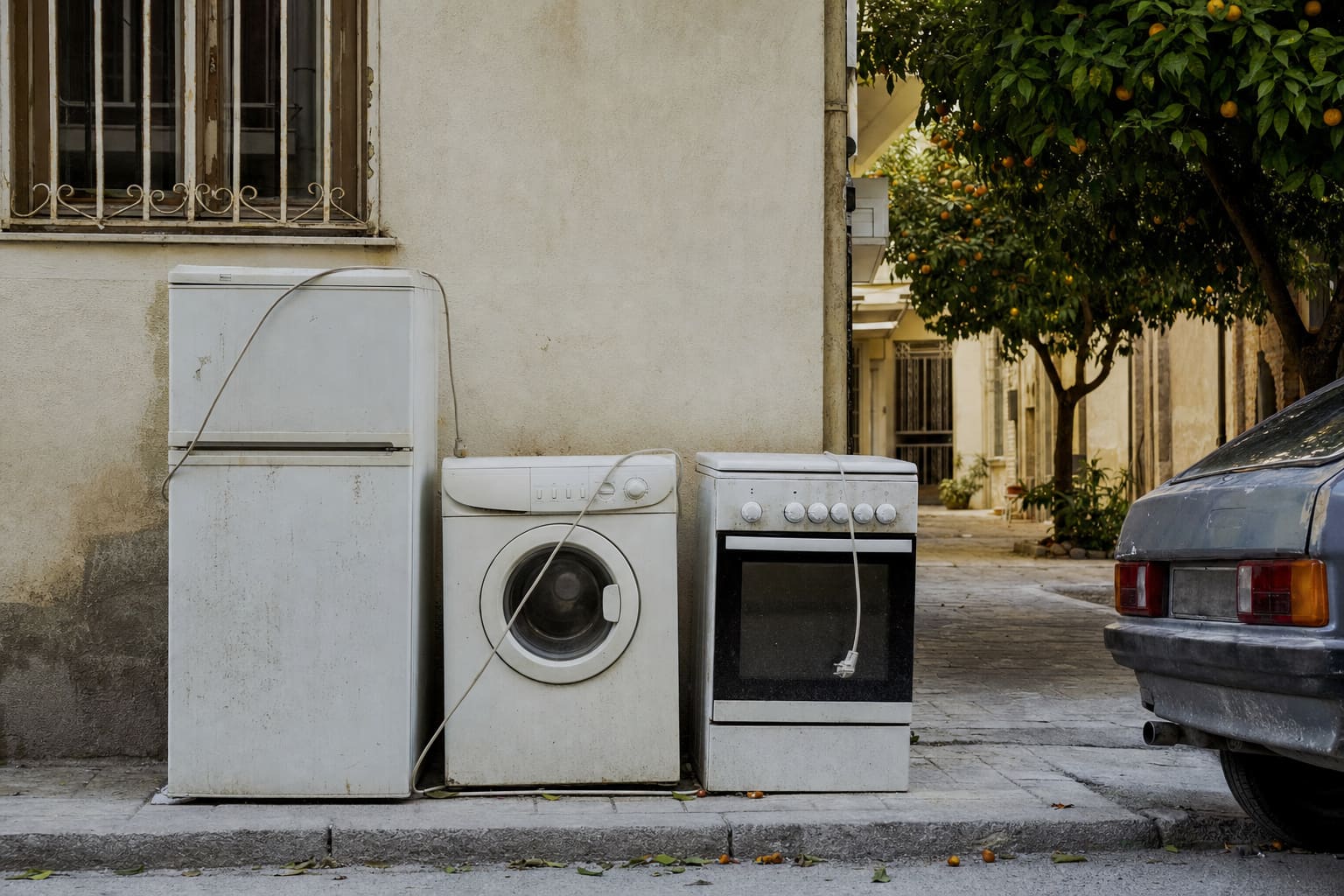
Don’t leave the old fridge next to the skip. The driver won’t load it, and it will stay on the pavement.
Where the waste goes afterwards
We collect the skip on the day you set and empty it at a licensed construction and demolition waste (ΑΕΚΚ) facility. There the waste is sorted. Concrete, bricks and tiles are crushed into recycled aggregate. Metal and timber go for recycling. What is left ends up in landfill.
The skip from your property
Licensed ΑΕΚΚ facilityThe load is sorted
- Concrete, bricks, tilescrushed into recycled aggregate
- Metal and timberrecycling
- What is leftlandfill
Each facility works with an approved ΑΕΚΚ management scheme, and the list of schemes is published by ΕΟΑΝ, the national recycling agency. If you need a waste receipt for the planning office or for your contractor, ask us for it in the chat. What a legal skip company must have and what the receipt says is in the guide Legal rubble disposal and waste receipt.