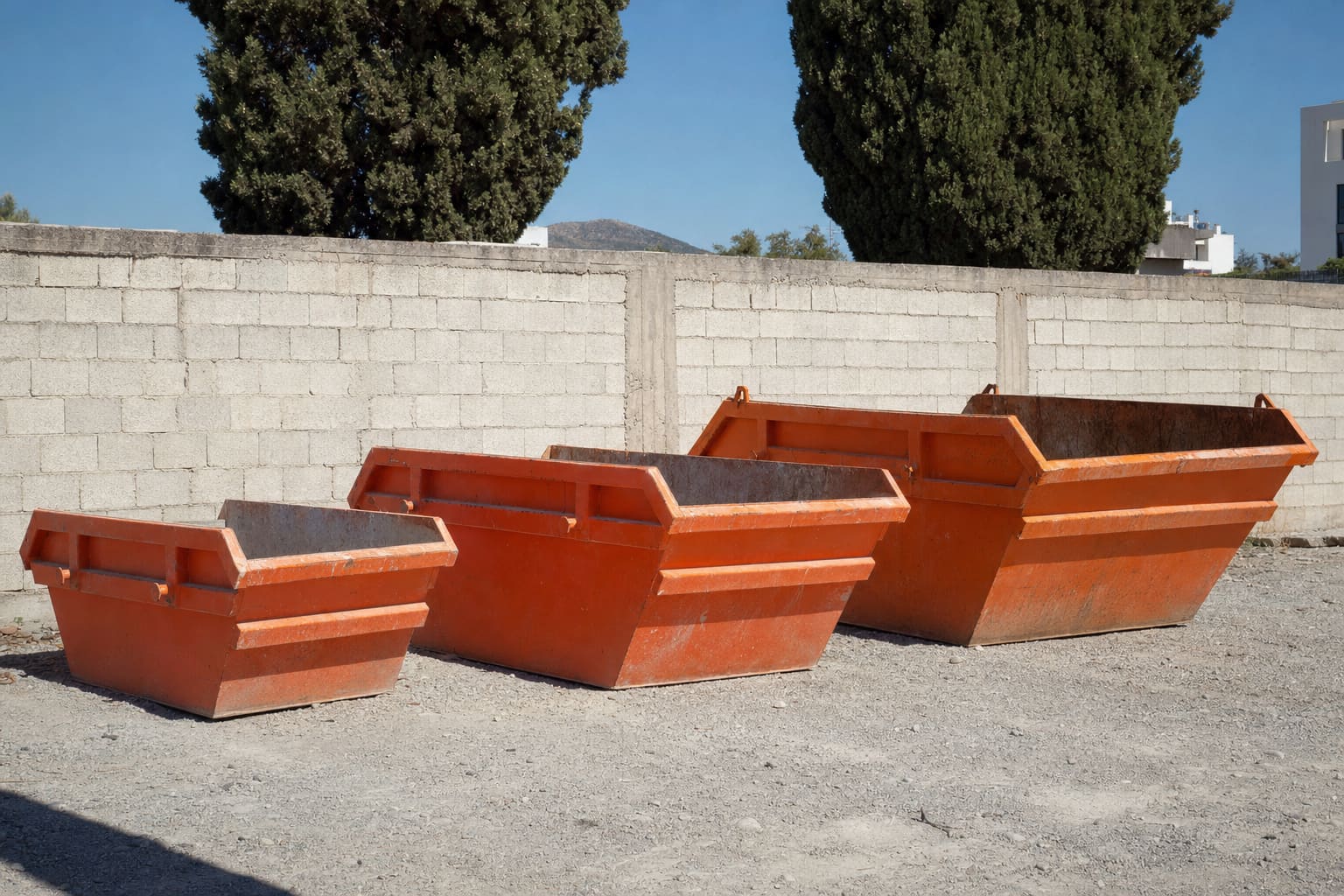
The sizes we have
from€190incl. VAT
3 m³ mini skip
One bathroom or a small kitchen, the tiles of one room, a storeroom. About 2.5 × 1.4 m: takes one parking space and gets into narrow streets.
Choose this sizefrom€290incl. VAT
6 m³ skip
A kitchen and a bathroom together, a few rooms of plaster and tiles, a house clear-out without big furniture. It still fits in one parking space.
Choose this sizeMost popularfrom€240incl. VAT
8 m³ skip
The standard builder’s skip: a whole flat renovated, the furniture of a house, a big garden. About 3.8 × 1.6 m, two parking spaces. With heavy rubble, fill it to about half.
Choose this sizefrom€270incl. VAT
10 m³ skip
Lots of bulky, light waste: furniture, mattresses, timber, prunings, packaging from a shop. For rubble, two smaller skips are better.
Choose this sizefrom€330incl. VAT
12 m³ skip
A house or shop being emptied, lots of furniture and timber, a large garden. Light waste only: rubble in a skip this size is too heavy to lift.
Choose this sizeHeavy rubble — concrete, tiles, soil — reaches the weight limit long before the skip looks full. If that is most of what you have, take a smaller skip and never load above the rim.
There are five sizes in all, and each city has three of them. The table shows how much room each one takes on the street, what job it is for and where you can get it.
3 m³2.5 × 1.4 m
6 m³3.5 × 1.5 m
8 m³3.8 × 1.6 m
10 m³4 × 1.8 m
12 m³4 × 1.8 m
A person, 1.75 m
| Size | About L × W | Street space | Typical job | Where |
|---|---|---|---|---|
| 3 m³ mini skip | 2.5 × 1.4 m | 1 parking space | One bathroom, a small kitchen, a storeroom | Athens, Patras, Larissa, Volos |
| 6 m³ skip | 3.5 × 1.5 m | 1 parking space | A kitchen and a bathroom together, plaster and tiles from a few rooms | Athens |
| 8 m³ skip | 3.8 × 1.6 m | 2 parking spaces | A whole flat, the furniture of a house, a big garden | All six cities |
| 10 m³ skip | 4 × 1.8 m | 2 parking spaces | Furniture, mattresses, timber, prunings, packaging | Thessaloniki, Heraklion, Patras, Larissa, Volos |
| 12 m³ skip | 4 × 1.8 m, taller sides | 2 parking spaces | A house or shop emptied, light waste only | Thessaloniki, Heraklion |
The cubic metres are approximate. A “7.5” and an “8” are the same skip, and so are a “3” and a “3.5”. A mini skip is about 1 m high and an 8 m³ about 1.5 m, which matters when you load by hand.
How much waste your job makes
Tick what you are doing and how many times. The numbers are for waste already broken up, which takes more room than the wall or floor it came from.
Bathroom stripped out
one bathroom of about 4–5 m² · 2–4 m³
0Kitchen taken out
units, worktop, wall tiles · 3–5 m³
0Floor tiles lifted
per 10 m² of floor, with the adhesive · 0.6–0.8 m³
0Brick wall knocked down
per 10 m² of wall · 1–1.4 m³
0Whole flat renovated
flat of about 70 m² · 12–20 m³
0Flat or house cleared out
furniture and belongings, about 70 m² · 8–15 m³
0Storeroom or basement emptied
one storeroom · 3–8 m³
0Garden cleared
prunings and green waste of a yard · 3–8 m³
0
Tick at least one job.
Tick the jobs you are doing and how many times: two bathrooms, 30 m² of floor tiles, one storeroom. The calculator adds up the cubic metres and suggests a size. The numbers are for broken material, which takes more room than it did in the wall.
- If most of it is heavy rubble, it tells you. Then a big skip is filled only to about half, or you take two smaller ones.
- If the total is more than the largest skip, it suggests two skips or swapping the full one for an empty one.
- Under 1 m³ it points you to rubble bags, which cost less than a skip.
When you aren’t sure, go with the higher number. A skip that fills up halfway through the job means a second order, while a bit of room left over costs you nothing.
How much waste each job makes
| Job | Waste, m³ | Which skip |
|---|---|---|
| Bathroom stripped out, 4–5 m² | 2–4 | 3 m³ mini, or 8 m³ where there is no mini |
| Kitchen taken out | 3–5 | 6 or 8 m³ |
| Floor tiles with adhesive, per 10 m² | 0.6–0.8 | For 40 m² of floor, a 3 m³ mini |
| Brick wall knocked down, per 10 m² | 1–1.4 | Heavy rubble: a smaller skip |
| Whole flat renovated, about 70 m² | 12–20 | Two 8 m³ skips, or one swapped full for empty |
| Flat or house cleared out, about 70 m² | 8–15 | 10 or 12 m³. In Athens, an 8 m³ and a swap |
| Storeroom or basement emptied | 3–8 | 3 to 8 m³, depending on the storeroom |
| Garden cleared | 3–8 | 8 m³, or 10 m³ for a lot of prunings |
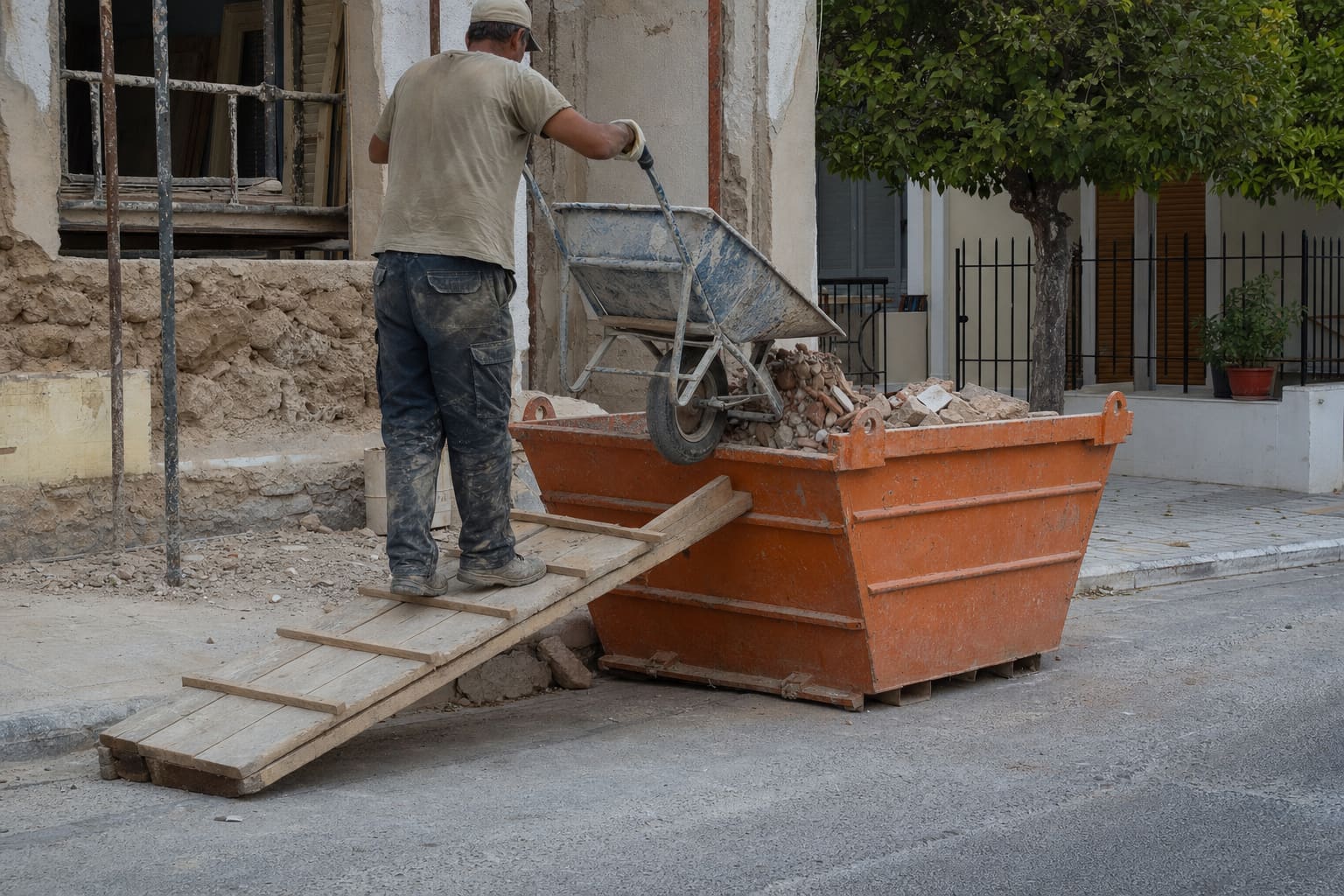
To work it out more closely, each square metre you strip out gives about: floor tiles with adhesive 0.06–0.08 m³, wall tiles 0.04–0.06, plaster 2 cm thick 0.03–0.04, brick wall 0.10–0.14, concrete 10 cm thick 0.13–0.16. Multiply by the square metres and add whatever else comes out: doors, cupboards, the toilet and basin.
Bulking and weight: why rubble needs a smaller skip
A wall in place is solid. Once it is broken, air is left between the pieces and the rubble takes 30–60% more room. Tiles grow by about 30%, bricks and plaster by about 40%, concrete by 50–60%, soil by 20–30%. The calculator above already counts this.
How much more room broken material takes
- Soil+20–30%
- Tiles+30%
- Bricks and plaster+40%
- Concrete+50–60%
- in place
- broken up
| Material | Weight per m³ |
|---|---|
| Mixed building rubble | 1.2–1.6 t |
| Concrete, marble, stone | 1.8–2.4 t |
| Soil | 1.5–1.9 t |
| Furniture | 0.1–0.3 t |
Do the sum: an 8 m³ skip full of mixed rubble weighs 10–13 tonnes. That is more than the lorry can lift. So with heavy rubble an 8 m³ skip is filled to about half, and with concrete or soil a little less. A 3 m³ mini skip of rubble comes to roughly 4–5 tonnes, which is why it is the skip people take for a bathroom.
The 10 and 12 m³ skips take light waste only: furniture, mattresses, timber, prunings, packaging. With rubble in it the skip can’t be lifted and stays where it is. For a renovation with a lot of rubble, take two smaller skips or ask for a swap.
Heavy rubble in an 8 m³ skip: to about half
Rubble first, light waste on top, up to the rim
Nothing above the rim
If you have heavy and light waste together, put the rubble in first, spread over the whole floor, up to about half. Then the light waste on top, up to the rim. Write in the order comment what is in it.
Why the sizes differ from city to city
In each city we run the skips its streets need. The form shows what is available at your address.
- Athens: 3, 6 and 8 m³. In the centre, in Koukaki, Exarchia and Psyrri, the streets are narrow and parking is scarce, so often only the 3 m³ mini skip fits. The 6 m³ is the in-between size for a kitchen and a bathroom. The 8 m³ is the usual skip in the suburbs, with wider streets and yards. For bigger jobs in Athens you take a second 8 m³ or a swap.
- Thessaloniki and Heraklion: 8, 10 and 12 m³. There are no mini skips here; the smallest is 8 m³. For a bathroom you take the 8 m³ and fill it with whatever you have. Under 1 m³, rubble bags cost less. The 10 and 12 m³ are for light, bulky waste.
- Patras, Larissa and Volos: 3, 8 and 10 m³. A mini skip for the bathroom, the standard 8 m³ for bigger jobs, and a 10 m³ for furniture and prunings.
Two skips or one big one
Two smaller skips, or one skip swapped full for empty, work better than one big skip when:
- Most of it is heavy rubble. An 8 m³ skip swapped once or twice takes the rubble of a whole flat without going over the weight limit.
- The street has room for one parking space. Two mini skips, one after the other, fit where an 8 m³ skip doesn’t.
- The work goes in stages. First the strip-out, then the old furniture a few weeks later. One skip per stage, so none stands empty running up days.
- You want the rubble apart from the light waste. One skip for rubble, another for furniture and prunings, so each one is filled properly.
A swap means we take the full skip and leave an empty one in the same spot. Ask for it in the chat when the skip is nearly full.