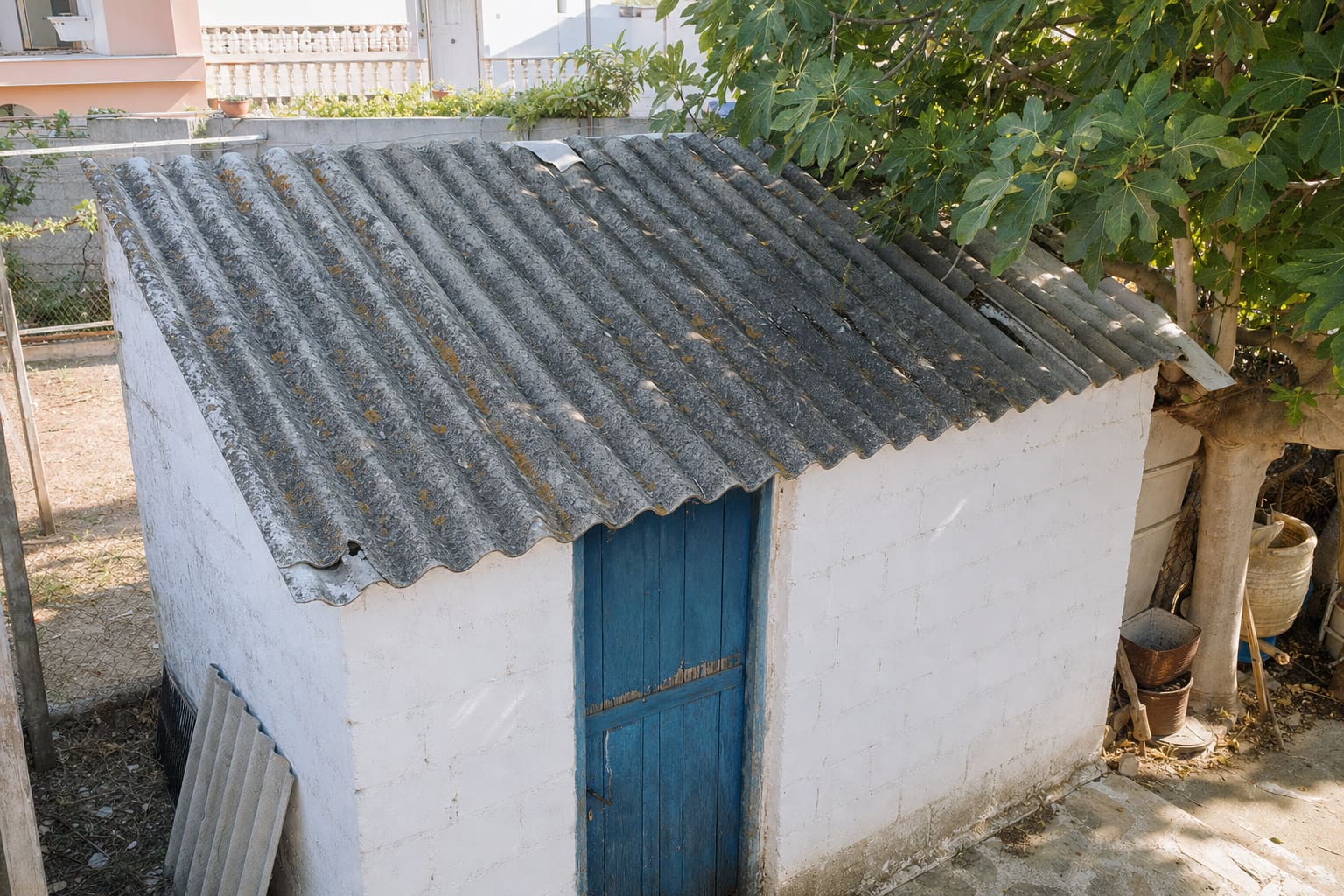
Where ellenit turns up in Greek buildings
Ellenit is mostly found on the roofs of storerooms, garages, stables, hen houses and industrial sheds, as grey corrugated sheets. Flat panels also turn up on outside walls and partitions.
- Corrugated roof sheets, lean-tos included.
- Flat sheets and panels.
- Drain, rainwater and flue pipes.
- Old water tanks on flat roofs.
- Insulation and coatings in older industrial buildings. Old vinyl floor tiles can contain asbestos too.
Asbestos was banned across the European Union from 1 January 2005 under Directive 1999/77/EC. The ban stops new use. Whatever was installed earlier stays in the building until someone takes it out. So a roof from before 2005 may contain asbestos, and one built later usually doesn’t.
How to recognise it, and what never to do
You can’t be sure by eye. Ellenit looks like a hard grey cement sheet, and old ones are often patchy with moss. If a material is old and you don’t know what it is, treat it as ellenit until a specialist has seen it.
The danger begins when sheets break and fibres get into the air. So:
- Don’t break it, cut it with a grinder or drill it.
- Don’t dry-sweep broken pieces or vacuum them.
- Don’t pressure-wash it. The jet strips material off and washes it onto the ground.
- Don’t walk on an ellenit roof. The sheets give way, and the fall can be serious.
- Don’t put it in a skip or leave it at a dump. Not even one piece.
When it can stay where it is
Sheets that are intact, sound and left alone can stay. Asbestos that is undamaged and not breaking up does not release fibres. It still needs a regular check.
Look for cracks, chips and wear along the edges, and for branches rubbing against the sheets. If you are planning a renovation, a demolition or a new roof, the material has to come out before the work starts, by the procedure below. For the rest of that kind of job, see the guide Renovation rubble.
This guide explains the procedure. Whether a particular sheet has to come out is for the licensed company to decide once it has seen it on site.
What the law says
Only asbestos removal and demolition companies (ΕΑΚ) may remove or demolish asbestos. They must hold a certificate from the Ministry of Labour’s Directorate of Health and Safety at Work and be entered in a register. KYA 4229/395/2013 sets the framework for these companies.
PD 212/2006 used to govern worker protection. PD 67/2026 (Government Gazette A’ 179/5.11.2026) replaces and repeals it. As a rule it requires the Labour Inspectorate (ΣΕΠΕ) to be notified at least ten working days before the work starts, and a work plan to exist before removal.
On waste, article 48 of Law 4819/2021 makes the owner, possessor or holder of a property responsible for keeping it free of hazardous waste, asbestos included. Only people with the relevant permit may collect and transport it. In the European waste list, asbestos cement carries code 17 06 05*. The asterisk marks it as hazardous.
The procedure, step by step
The owner asks a licensed ΕΑΚ for a quote, and the company takes care of the rest. In order:
| Step | What happens | What you should hold |
|---|---|---|
| 1. Choose the company | Check that it holds an ΕΑΚ certificate from the Ministry of Labour | The certificate number and a written quote |
| 2. Plan and notification | The company draws up a work plan and tells the Labour Inspectorate before it starts | A copy of the notification |
| 3. Removal | The sheets come off whole, with measures to keep dust down, and are wrapped in impermeable material and labelled | Nothing. Stay away from the area |
| 4. Transport | A vehicle licensed for hazardous waste carries them away | The transport document |
| 5. Final disposal | They go to a licensed hazardous waste facility or are exported | The receipt for delivery and disposal |
Keep the papers from step 5. They prove the ellenit did not end up somewhere else. For the legal route of rubble in general, see the guide Legal rubble disposal.
The Ministry of Labour keeps the list of licensed ΕΑΚ. The procedure for issuing the certificate is on mitos.gov.gr. Ask the company for its certificate and check it before you pay a deposit.
The same article (48 of Law 4819/2021) allows a small amount of non-friable household asbestos to go to a municipal facility, provided it is well wrapped in impermeable material or a bag. Each municipality sets its own terms and cost, so ask yours first.
What it costs, and why there is no single price
We give no figure, because we could not find two current Greek sources that agree. Companies usually charge per square metre of roof or per kilo of material, and quote after a site visit.
- Area and weight. The more square metres, the higher the price.
- Access and height. A roof high off the ground needs scaffolding or a lift.
- Condition of the sheets. Broken or worn sheets call for more protective measures.
- Distance to the disposal facility, since this waste is not accepted everywhere.
- Disposal fee and paperwork. The notification, the plan and the disposal all go into the quote.
Ask for a written quote that covers everything: removal, transport, disposal, paperwork. Two quotes are enough to show whether one is out of line.
If ellenit is found in a skip
Ellenit in a skip means the recycling plant refuses the load and the customer pays. That is our rule for every skip, even when it is a single broken piece under the rest of the rubble.
The owner faces a similar risk. If hazardous waste is not cleared from a property, the Decentralised Administration can order the owner to do it within 20 days. If the owner doesn’t, the authority removes it and bills the owner (article 48 of Law 4819/2021). For fines in general, see the guide Fines for illegal dumping.
And the rest of the job
Once the ellenit is gone, the rest of the job goes in an ordinary skip. In an old shed that means bricks, concrete, roof timber and metal. To pick a size, see Which skip size. Prices are on the page Skip prices.
A skip costs from €190. That includes 10 rental days, delivery, collection and disposal at a licensed ΑΕΚΚ facility. If you are emptying a whole storeroom or basement, there is also the guide Clearing a space. What we don’t take is listed in What goes in a skip.